
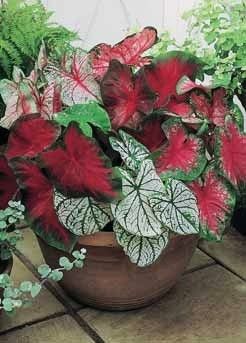
Who says container plants have to be brimming over with colorful flowers?
Last week I blogged about how container plants can help sell your home. Today, I’m focused exclusively on foliage container plants for home staging.
I’m a firm believer that greenery alone brings enough variety of color and textures, and that foliar plants are easier to take care of than blooming annuals.
I’ve chosen nine dramatic but low-maintenance ones that are perfect for adding all-important curb appeal, and for otherwise dressing up your landscape.
Caladium
I like the big, tropical leaves on these variegated plants. They move in the gentlest breeze. They’re dramatic. They’re colorful. They’re relaxing.
Caladium tubers won’t sprout until the soil is warm, so if you want Caladium plants and you buy packaged tubers in late spring, I hope you are a patient person, because it will be mid-summer before you have a decent potted plant. Nurseries carry lush potted Caladiums that are irresistible. You’ll find them in all kinds of fascinating variegations – from simple green and white to exotic lavender polka dots.
Caladiums can be the accent plant in a potted container of foliage plants, or the singular star of the show. They do best in the shade, and in a moist environment. If that sounds like your porch or a shady spot near a fountain or water feature, Caladiums could be all the potted plant you need, their brightness calling attention to one of your home’s selling points.
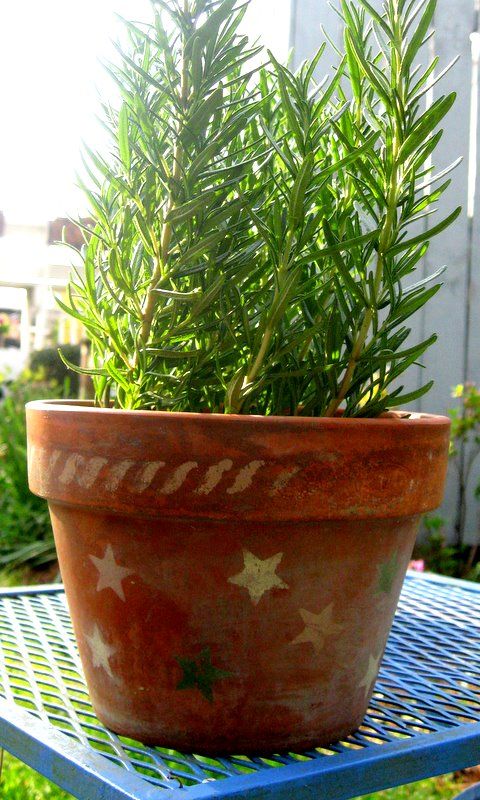 |
| Rosemary tops my list of trouble-free plants. |
Rosemary
What’s not to love? She looks good all year long. She’ll grow in almost any kind of soil except poorly drained. She does not taste good to pests, including deer. She’s fragrant, and can be used to make a more interesting focaccia or stew.
She laughs at all the usual plant diseases. She’s available as an upright or a trailing plant. And she can even be pruned to take on different shapes, including topiary. .
Buying a potted Rosmarinus officinalis plant is an investment you’ll never regret, because you can take it with you when you move. This is the perfect container plant to put in a sunny spot where you may forget to water on a regular basis.
Heuchera
You may know Heuchera by its common name, coral bells. Heuchera is another investment plant. In containers, it is easy to winter over unless your winter temps go below minus 25 degrees.
You can plant containers now with Heuchera and they will look good through the fall. These lovelies are almost impossible to kill.
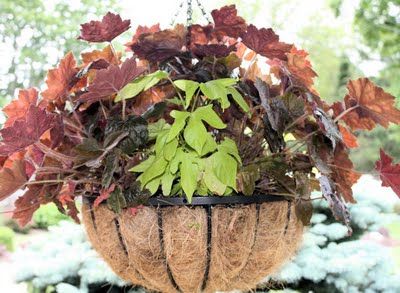 |
| This sweet potato vine will become the spill plant when it matures a bit, and the domed huechera plant is both a thrill and a fill plant. Photo: Landscape Design by Lee |
Choose colors that accent your home’s best features. Different varieties of Heurhera come in mauve tones, silvery shades, and lime green colors. Many have two-toned leaves with distinctive veins in contrasting colors to make them even more showy.
A beautifully shaped Heuchera plant is the perfect thrill plant in a container, or the filler plant surrounding a larger focal point plant.
Because Heuchera are not fussy about sunlight, your container can be placed in sun or shade, or a combination, like that area on the east side of your home that gets bright sun in the morning and deep shade all afternoon. They are drought tolerant, making them a good candidate for a hanging basket.
Coleus
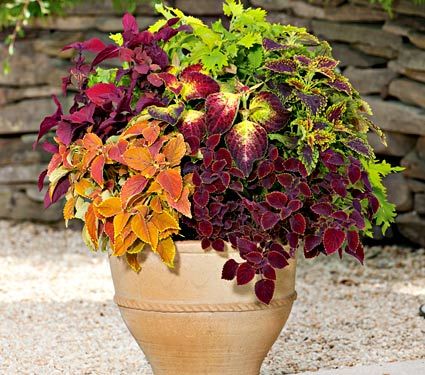 |
| Six varieties of coleus fill this clay pot, which will look only more exotic as summer progresses. Photo: White Flower Farms |
The best part is that they are not demanding. Coleus will thrive in the shade, and they don’t need frequent watering or fertilizing to keep them perky.
When they are thirsty, they might look a little limp, but they are the kind of plant gardeners call “signal plants.” Signal plants, like impatiens, signal you when they need water, unlike some divas, that just die, not mentioning any names, like Petunias.
Coleus plants do send up flower spikes, but most people pinch them off. With coleus, it’s all about the stunning leaves.
Persian Shield
 |
| Persian Shield and Creeping Jenny share the technicolor spotlight in this foliage-only grouping. Photo: la fattina via Garden Pics |
Look for this pretty plant early in the season, because it can sell out fast. What makes Persian Shield so desirable are the purple leaves that are so iridescent I wouldn’t be surprised if they glow in the dark. Ask at your savvy nursery for strobialanthus dyerianus.
Persian Shield will be happy in sun, part sun, or shade. You will love this plant because it is so unusual. People touring your home will think you have a gardener on staff!
I suggest that you place it in shady spots because it does like moist soil, and you don’t want to be dragging a hose or watering can around twice a day.
Trailing Ivy
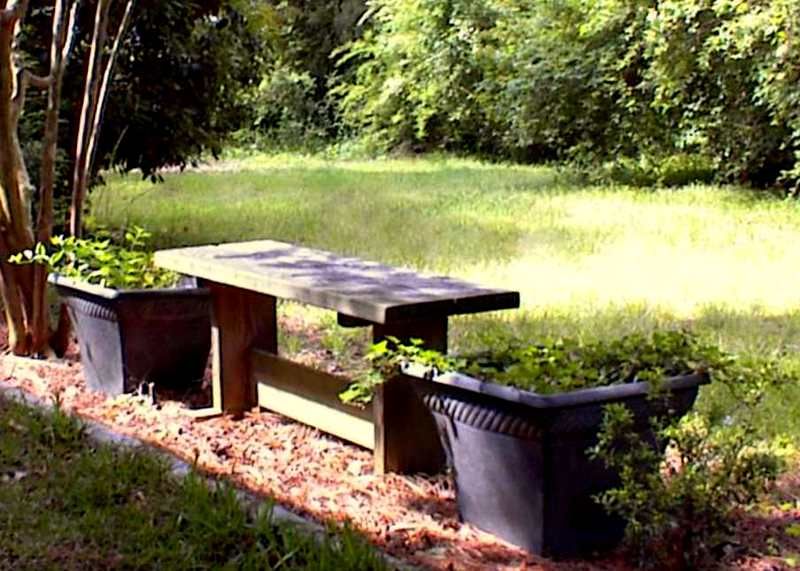 |
| I planted these two faux finished containers with ivy and set them on the edge of our property to give some importance to an ordinary bench. Fortunately, ivy doesn't mind being ignored. |
All ivies are easy to grow. In containers, they act as both fillers and spillers, and can be striking on their own or mixed with other greenery or blooming plants.
Don’t be put off by their commonness. All ivies are not alike. You can find the sexy varieties in the houseplants department, so look there instead of in the groundcover department.
If you have a balcony or small sideyard that doesn’t get much attention, trailing ivy could be your go-to container plant, the one that adds fresh growth and texture to the area. Ivy plants don’t mind neglect, will tolerate full shade or full sun, and even keep on looking handsome despite periods of drought.
Tradescantia
This common houseplant is easy and fast-growing. In places where winters aren’t harsh, it will return yearly from pots or the ground. Its fleshy stems which sprout pretty 2-inch, purple -- sometimes striped -- leaves, can spill from containers, making it an ideal hanging plant.
It does show small pink flowers mid-season, but these are incidental to its value as a container plant.
It does show small pink flowers mid-season, but these are incidental to its value as a container plant.
If your tradescantia plant is growing leaves that are too far apart, it’s not getting enough light. Prune it back and move it to a sunnier spot for a more compact plant.
 |
| It's not flashy, but tradescantia the perfect plant for use as a spiller or as a solo specimen. It likes bright but indirect sun. Photo: Life Among Lilacs. |
Golden Creeping Jenny
Her botanical name is Lysimachia nummularia, but her friends call her Creeping Jenny or Moneywort, and she has lots of friends.
On the ground, she’s a ground cover, but in containers, she’s a spiller. Her small yellow leaves create the perfect contrast to plants with ordinary green leaves.
Creeping Jenny will not disappoint you over the course of the summer. This is a plant that is easy to cut back if it gets too ambitious. No diseases are common, but sometimes rust spots occur. You can just snip off the affected parts.
Grow Creeping Jenny in full sun or part shade, in a container that will be easy to water, because, although she won’t perish, she doesn’t like really dry conditions.
Sweet potato vine
I considered not including this plant because you see it everywhere. The reason it’s so popular is its tropical-like chartreuse or maroon leaves on vines that ramble, filling in spaces on the ground and spilling over the sides of pots.
These Ipomea batatas will grow in the shade and not require as much water there, but the leaves will not be as intensely colored. If your sweet potato vine gets too leggy, it’s easy to cut it back without harming it. In fact, it will only grow fuller and more luxuriant.
Top photo: Gardenality

